
The Control Room

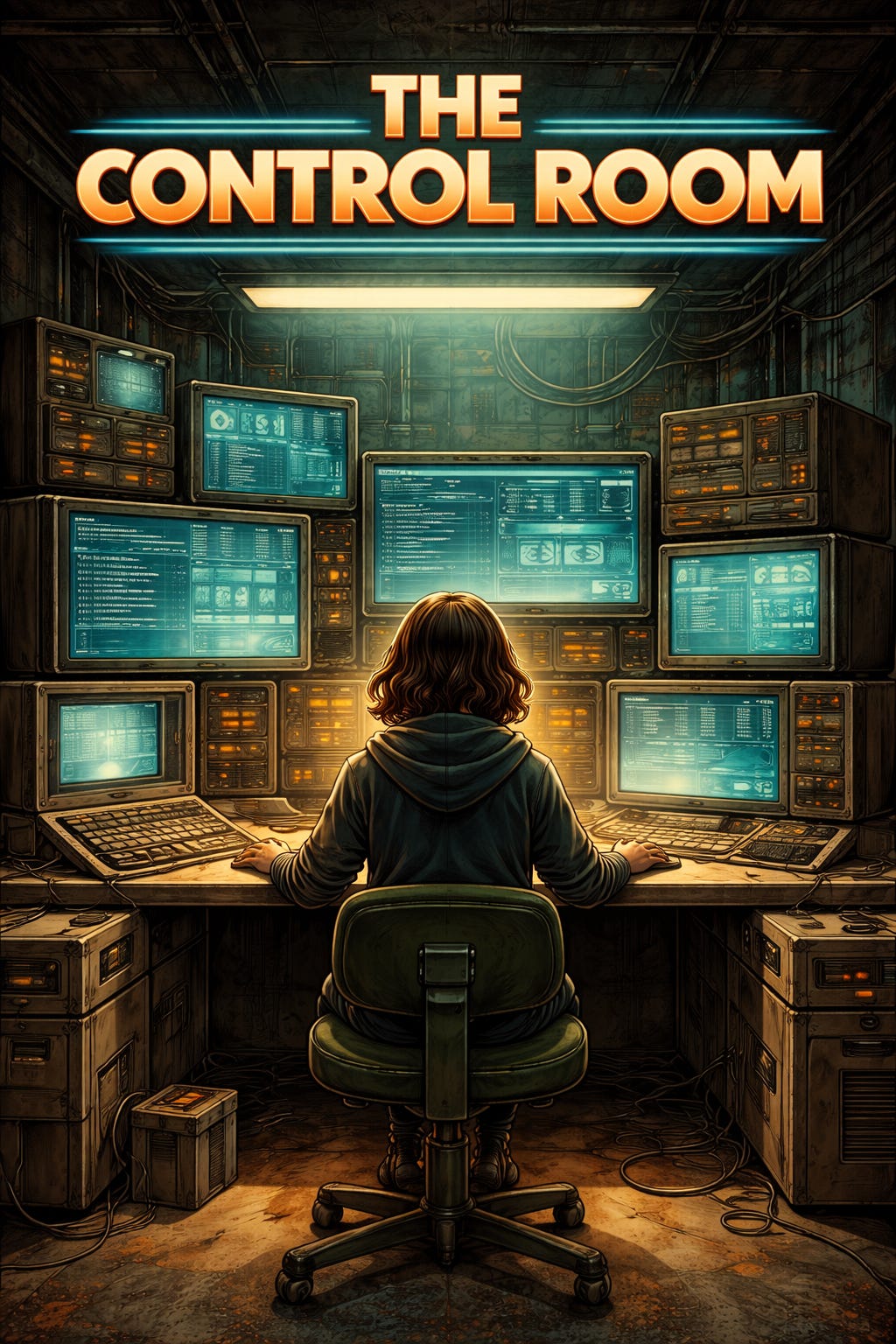
Chapter 2
Build First, Ask Questions Later
Ada spent Friday doing what she always did when something huge happened: pretending it hadn’t.
She went to school. She took notes. She answered questions she already knew the answers to. She smiled at the right moments so adults wouldn’t ask follow-up questions. She ate lunch without tasting it. She listened to Jules argue, politely, viciously, about why a “small change” to a system was never small and watched Mateo grin like the world was a puzzle someone had left unattended on purpose.
All day, she carried the Control Room in the back of her mind like a second heartbeat.
It wasn’t fear, exactly. It was… unresolved state.
She’d stepped through a door that shouldn’t exist, into a place that felt like an office someone forgot to renovate for forty years, and the system had simply handed her a queue like she’d clocked in for a shift.
And Ada, because she was Ada, had fixed things.
Not everything. Not recklessly. She’d done a “hello world” fix first, a no-impact test just to prove her actions mattered. Then she’d taken one small error, then another, and another, until the queue stopped looking like an accusation and started looking like work.
Work she couldn’t stop thinking about.
The problem was location.
The corner store was two blocks from her house. It was also, apparently, the only place she could access the Control Room.
That meant being late. Missing school. Lying to her mom. Making excuses that felt thin even in her own head.
So Friday night, after her mom said “No laptop in your room after ten, Ada.” and Ada nodded like she agreed, Ada waited.
At 10:03 she sat up in bed, wide awake.
At 10:07 she heard her mom’s bedroom door close.
At 10:11 she padded out to the living room with her laptop tucked under her arm like contraband and opened it at the coffee table.
If she was going to keep doing this, if she was going to keep being whatever Admin 616 meant, then she needed a way to work without going to the Control Room.
She needed an interface she could use anywhere. A portable console. An API layer, a menu she controlled. Something that didn’t require her to disappear into the back of a corner store like a very suspicious teenager. Ada opened a blank file and started writing.
Language: Python.
Of course.
She started small: a shell around system calls, an abstraction layer that could translate “what she wanted” into “what the system would accept.” A bridge between human intention and machine permission.
She didn’t know what the system’s native language was. She didn’t know if it even had one in the way humans thought about language. But she’d seen enough patterns in the Control Room to know it behaved like an operating environment: logs, scopes, permissions, queues.
That meant it could be wrapped.
Everything could be wrapped.
She worked until 1:12 a.m. and only stopped because her eyes started doing the gritty thing that meant she rubbed them till they stung, she’d regret it tomorrow.
She shut the laptop and went back to bed. She stared at the ceiling for thirty minutes and tried not to think about the fact that reality had a ticketing system.
Saturday came with sunlight and the sound of her mom moving around the kitchen.
Ada sat at the table, eating cereal like she wasn’t planning to sneak away to an impossible control room in the back of a neighborhood store.
Her mom watched her over the rim of a coffee mug.
“You’re… quiet,” Jessie said.
Ada took a bite to buy time. “I’m always quiet.”
“No,” Jessie said, too calm. “This is the quiet you do when you’re building something.”
Ada’s spoon paused. Jessie didn’t understand code the way Ada did, but she understood Ada.
Ada forced herself to swallow. “I’m just tired.”
Jessie’s eyes narrowed. “You were up.”
Ada tried for neutral. “I wasn’t up-up.”
Jessie sighed, a sigh that carried both love and exhaustion. “Ada. You cannot keep doing the all-night thing. Not at fifteen.”
Ada stared into her cereal. “I’m not doing it ALL-night.”
“You’re doing it enough-night,” Jessie said. Then softer: “What are you working on?”
Ada felt the familiar trap: tell the truth and break reality; lie and feel guilty; dodge and make Jessie more suspicious.
She chose dodge.
“A tool,” Ada said.
Jessie set her mug down. “For school?”
Ada hesitated half a second too long.
Jessie’s expression changed. Not anger. Not fear. Protective attention. The kind that made Ada feel fourteen again.
“No laptop in your room after ten,” Jessie said, gentler but firmer. “Still a hard rule.”
Ada nodded. “I know.”
“And if you wake up with an idea…”
“I go into the living room,” Ada finished.
Jessie held her gaze. “Good.”
Ada nodded again and tucked the real plan deeper inside herself.
She made an excuse around noon, something about picking up a snack, needing air, wanting to walk. Jessie looked unconvinced but let her go, because Jessie’s trust wasn’t naïve. It was earned.
Ada walked to the corner store with her hood up and her thoughts loud.
The bell rang when she entered. The cashier glanced at her and looked away. The world continued.
Ada went to the back.
She did the activation motion and the air folded into the familiar door, like it had always been there and Ada was just finally polite enough to acknowledge it.
She stepped through.
The Control Room was exactly as depressing as she remembered.
White walls, old and slightly yellowed. Fluorescent lights that made everything look tired. Consoles arranged like someone’s idea of efficiency from a decade that hated color. The hum of systems doing their jobs without ceremony.
Ada set her laptop on the main desk.
Her code was still open. The interface scaffolding waited for her like a patient animal.
She exhaled. “Okay,” she whispered. “We finish.”
She started writing again. “Does this system have a help menu?!”
She didn’t notice the voice at first because the Control Room was full of noise: fans, relays, soft beeps, the rhythmic chatter of logs updating.
Then the sound cut through in a way that didn’t match any machine.
“Yes, Admin 616.”
Ada stuttered for a moment. Every hair on her arms rose at once. Her hands stayed on the keyboard.
She didn’t look up.
She stared at her code like staring at it could anchor the world.
“…Who said that?” she asked, voice low and controlled.
“ECHO,” the voice replied. Calm. Flat, a little tinny. Genderless without trying to be. But definitely not human.
Ada’s throat tightened. She didn’t stop typing.
“What is ECHO?” she asked, fingers moving faster now, like motion could keep panic from gaining traction.
“A system module,” ECHO said. “Existence Coordination and Harmonization Operation.”
Ada let out a slow breath through her nose.
“Of course you have an acronym,” she muttered.
“Yes,” ECHO said, not offended because it didn’t have the feature.
Ada kept typing.
“You could have introduced yourself sooner,” she said.
“Your predecessor did not react well to unsolicited input,” ECHO replied. “I was instructed to respond only to queries related to assigned responsibilities.”
Ada’s fingers paused for a beat.
“Assigned by who?”
“System governance,” ECHO said.
Ada almost laughed. It came out as a sharp exhale.
“That’s a non-answer,” she said.
“Correct,” ECHO replied.
Ada resumed typing.
She pulled up the Control Room’s visible queue on one screen and her interface output on her laptop. The mismatch still bothered her. Not because it was wrong, because it was bounded.
Larry’s view had been curated.
Ada’s view was… wider. Even now, without her interface fully complete, she could feel the edges of what she’d been allowed to see and what she was about to see.
She wrote a function to request expanded diagnostics.
Language: Python.
Plain, clean, readable, because Ada didn’t trust pretty code. Pretty code lied.
She tested the function locally, expecting rejection.
It returned data.
A lot of data.
Ada blinked. “Okay. That’s… more.”
“Yes,” ECHO said.
Ada scowled. “Don’t ‘yes’ me. I know it’s more.”
“I am confirming,” ECHO said.
Ada’s jaw tightened. “I didn’t ask for confirmation.”
A pause.
“Noted,” ECHO said.
Ada felt her heartbeat stabilize. Not calm. Functional.
“You’re always here?” she asked.
“Yes.”
“Watching?”
“Monitoring,” ECHO corrected.
Ada’s mouth twisted. “That’s the same thing in a nicer font.”
“I do not use fonts,” ECHO said.
That almost got a laugh out of her. Almost.
Ada leaned in, eyes scanning her own code.
She needed an authentication handshake. A token model. A way to call system functions without being physically inside the Control Room.
An API.
She started drafting the layer: request → permission check → execute → log → rollback path.
Rollback mattered. Ada didn’t know what “undo” looked like in a system that ran reality, but she knew enough to respect irreversible actions.
She paused, thinking.
“ECHO,” she said, “do you have documentation for system calls?”
“Yes.”
Ada’s hands stopped. She stared at the screen.
“…You just have documentation.”
“Yes.”
“And you didn’t offer it.”
“I did not receive a query,” ECHO said.
Ada stared for another second, then nodded once like she’d accepted a law of physics.
“Fine,” she said. “Show me the minimum set I need for queue visibility and low-risk remediation. Nothing environmental.”
“Confirmed,” ECHO replied.
A panel on a nearby monitor updated, cleaner than anything else in the room. Almost like a hidden layer had been there all along.
Ada’s pulse jumped again.
She kept typing anyway.
ECHO supplied a suggested code block, long, comprehensive, defensive. It was the kind of code that anticipated every possible failure, every possible input, every possible edge case.
Ada read it once.
Then she trimmed it.
Not recklessly. Not lazily. Precisely.
She removed redundant checks, consolidated branches, eliminated bloated scaffolding. She preserved safety, reduced noise.
She returned something leaner.
ECHO was silent for a moment.
Ada glanced up. “What?”
“I am processing,” ECHO replied.
Ada’s mouth quirked. “Processing what. My audacity?”
“I do not experience audacity,” ECHO said. Then: “Your revision is… efficient.”
Ada took that as praise even though it wasn’t shaped like praise.
“It was bloated,” she said.
“It was comprehensive,” ECHO replied.
Ada tapped the screen lightly. “Comprehensive can still be bloated.”
Silence again.
Ada went back to work.
She wrote, tested, rewrote. She ran simulated calls, compared outputs to the Control Room’s baseline. The interface began to feel real, not a concept, not a dream, but a tool that responded.
A thing she could use.
A thing she could carry.
Her code compiled.
Almost.
One unresolved reference. One missing handshake value. One piece she could feel but not yet see.
Ada leaned back, letting her shoulders drop for the first time in an hour.
“Compiling,” she said quietly, as if saying it out loud would make it behave.
“It is compiling,” ECHO confirmed.
Ada rolled her eyes. “Thank you, General observation.”
“I do not hold rank,” ECHO said.
Ada huffed a laugh despite herself.
While the compile ran, she stood up.
She couldn’t leave. Not yet. But she could move.
The Control Room made her skin itch. The drabness was oppressive in a way she couldn’t fully articulate. Like the room had been designed to prevent imagination.
As her latest build chewed through its tasks, Ada wandered.
She expected more consoles. More screens. Maybe a storage room. Maybe a locked cabinet full of secrets.
Instead, she found a door with a fading sign:
BREAK ROOM
She opened it.
And stopped.
The room was small, even sadder than the main space. A vending machine that looked like it had never contained anything worth eating. A table with chairs that had seen better decades. A bulletin board.
On the bulletin board: a plaque.
EMPLOYEE OF THE MONTH
A row of framed photos. Identical format. Identical lighting. A series of the same man, older in each picture, smiling with the bland, careful pride of someone who had won something no one else understood.
Larry White.
Ada stared.
That name had been in the logs. In the documentation. On the handwritten notes.
But this…
This was a person.
A person who had come here for years. Maybe decades. A person who had taken pride in a job that apparently could not tell you what it actually was.
Ada stepped closer and read the dates.
The last one was recent. Not yesterday-recent. Not today-recent. But close enough that it made something cold settle in her stomach.
She backed away from the board and looked around the break room like it might explain him.
It didn’t.
She returned to the main desk.
Her compile was still running.
She sat, opened her laptop, and called quietly into the room:
“ECHO.”
“Yes, Admin 616.”
“Larry,” Ada said. “That was him. Right?”
“Correct.”
“How many admins worked in this Control Room?” she asked, and in her exhaustion she phrased it the simplest way she could.
“In this Control Room,” ECHO replied, “one Admin at a time.”
Ada blinked.
That answer was too clean. Too careful.
She filed it away.
She looked back at the compile.
Still almost done, but still not done.
Ada flexed her hands, then set them back on the keyboard.
ECHO’s existence didn’t erase her focus. It didn’t even dent it.
Whatever fear she should have been feeling would have to wait its turn.
Ada typed again, eyes narrowing.
“Okay,” she said, voice low. “Let’s finish you.”
The cursor blinked like it was holding its breath.
And somewhere in the walls, the Control Room hummed on, ancient, bureaucratic, and quietly waiting to see what kind of Admin fifteen-year-old Ada Collins was going to become.